How to Choose Between a Humidifier and a Diffuser for Your Brand
In short
A humidifier adds moisture to the air; a diffuser adds fragrance. They solve different problems, carry different certifications and different packaging costs, and rarely share a shelf position. If your channel is mostly search-led, humidifiers win on intent. If your brand sells atmosphere, diffusers carry higher perceived value per unit. The decision is about which claim you can support, not which unit is cheaper.
What each unit actually does
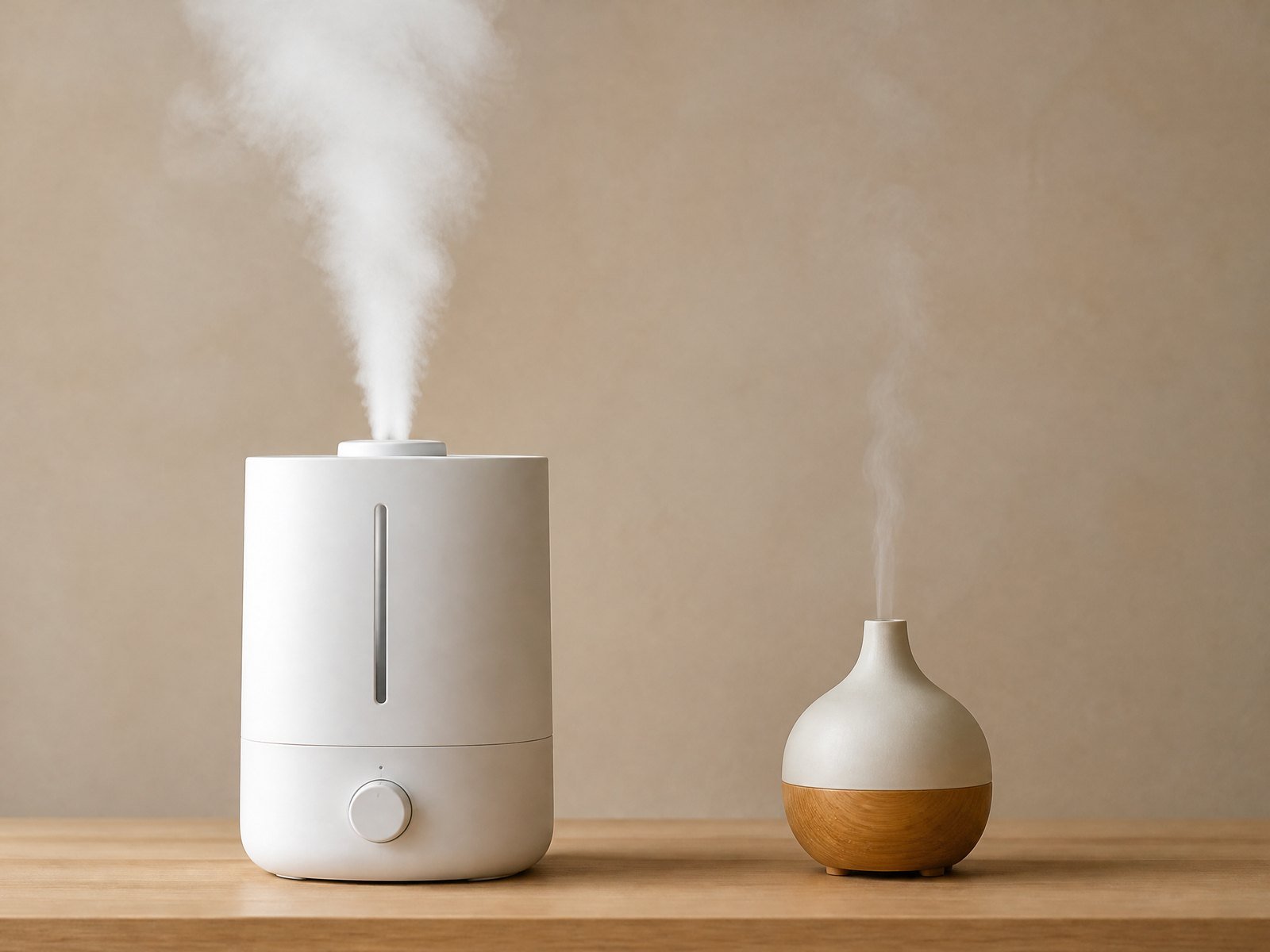
A humidifier puts water vapour into the air. A diffuser puts fragrance oil into the air. On a spec sheet they look similar — a tank, an ultrasonic or nebulising element, a fan, a PCB — but the thing they deliver to the end user is different, and that difference drives everything downstream: the claim on the box, the certification file, the return rate, and what the buyer expects to happen after thirty days of use.
A humidifier is bought to change a measurable condition. The buyer has dry air, or a bedroom that feels stuffy in winter, and expects the unit to move a number — output in millilitres per hour, coverage in square metres. A diffuser is bought to change a feeling. The buyer wants a room to smell the way a hotel lobby smells, and the unit is judged on consistency and silence rather than on throughput.
How buyers decide between the two
In our experience the split is predictable. Humidifiers dominate search-led demand: someone types a problem, adds a room size, and buys. Diffusers dominate gift, home-fragrance and hospitality demand, where the product is chosen alongside a scent rather than instead of one.
- Problem-led buyers (dry air, winter, nursery, office) — humidifier. They compare capacity and noise.
- Atmosphere-led buyers (home fragrance, spa, hotel, retail gifting) — diffuser. They compare design and scent range.
- Facilities and commercial buyers — usually diffusers, and usually specified per zone rather than per unit. The hotel scenting guide covers how that specification works in practice.
If your brand already sells scent, a diffuser extends the range. If it sells home comfort or air quality, a humidifier is the shorter step. Launching both at once splits your certification budget and your packaging minimums across two lines.
The units we build
Four product lines run through the factory: humidifiers, aroma diffusers, air purifiers and dehumidifiers. The two lines relevant here:
| Model | Type | Tank / capacity | Output | Coverage |
|---|---|---|---|---|
| HUM-TF-450 | Top-fill ultrasonic humidifier | 4.5 L | 300 mL/h | up to 40 m² |
| HUM-US-300 | Ultrasonic humidifier | 3.0 L | 250 mL/h | up to 30 m² |
| DIF-EO-200 | Essential-oil aroma diffuser | 200 mL | up to 6 h run time | up to 20 m² |
| DIF-CM-1000 | Cold-air nebulising diffuser | 1000 mL | — | up to 300 m² |
Note the last row: the commercial diffuser is not a bigger home diffuser. It is a different architecture, aimed at a room an order of magnitude larger, and it is specified per zone. That is why commercial projects are scoped differently from retail SKUs.
What moves cost and MOQ
Neither line has a single MOQ number that applies to every order — ours are quoted per project. What moves the number is the same for both:
| Lever | Humidifier | Diffuser |
|---|---|---|
| Housing colour | Adds a minimum per colour | Adds a minimum per colour |
| Packaging structure | Usually the largest lever — a new insert or gift box resets the run | Same, and gift boxing is more common in this category |
| Manual and language set | Adds a minimum per language | Adds a minimum per language |
| Scent or oil included | Not applicable | Changes shipping class and labelling, and often the MOQ |
| New tooling | Only for a new housing or tank shape | Same |
The practical consequence: choose the model and the packaging before you negotiate quantity. The MOQ guide breaks the number into its levers. A brand that picks a stock model with stock cartons can order far less than one that wants a new housing and a rigid gift box, and the difference is usually packaging rather than the appliance.
Certifications are not the same for both
Both lines sit under the same family of household-appliance safety standards. IEC 60335-2-98 covers humidifiers specifically, and IEC 60335-1 is the general requirement underneath it. In North America the product standard we work to is UL 998 for humidifiers. In the EU the applicable directives are the Low Voltage Directive, the EMC Directive, RoHS and REACH. Japan and Korea each have their own regime.
The difference is not the standard — it is the file. A diffuser that ships with oil raises labelling and transport questions a humidifier never has, and a commercial diffuser installed in a public space raises questions a retail unit does not. If you plan to sell both lines in the same market, budget the certification work as two files, not one. The certification routes by market are set out separately for each destination.
Packaging and claims
This is where most first SKUs lose money. Humidifier packaging is usually protective and functional: moulded pulp or EPS, a printed carton, a manual. Diffuser packaging frequently wants to look like a gift, which changes the carton, the insert and the unit cost at the same time.
Claims need the same discipline. Humidifier copy should describe comfort and conditions — comfortable humidity, quieter nights, less dry-air discomfort — and must not claim to treat or relieve a medical condition. Diffuser copy describes ambience. Both are checked by marketplaces and, in the EU, by consumer-protection authorities; a claim you cannot support is a return and a takedown, not a marketing win.
How to scope a first order
A workable sequence, in the order that costs least to change:
- Pick the line from the buyer, not from the catalogue.
- Pick a stock model and confirm the market's certification route before artwork.
- Fix packaging structure next — it sets the MOQ more often than the appliance does.
- Then negotiate quantity and schedule. Production runs 15–30 working days after approval; sampling runs 5–15 working days.
- Agree the after-sales path in writing. Warranty is 12 months from receipt, claims are acknowledged within 24 hours, and we ask that a claim be raised within 7 working days of delivery.
If you are still deciding
Send the market, the channel and the shelf position you are aiming at. We will tell you which line fits, what the certification route looks like, and what the packaging decision does to your first order — before you commit to artwork. Request a quote or compare the full range on products.
Filed under OEM & ODM. Back to all guides.